An Editorial Synthesis
Welcome to
The Human Premium.
In a world of commodity intelligence, value lies in judgment, taste, and human trust.
This page synthesizes content from key thought leaders that you can explore with links to their full articles or videos.
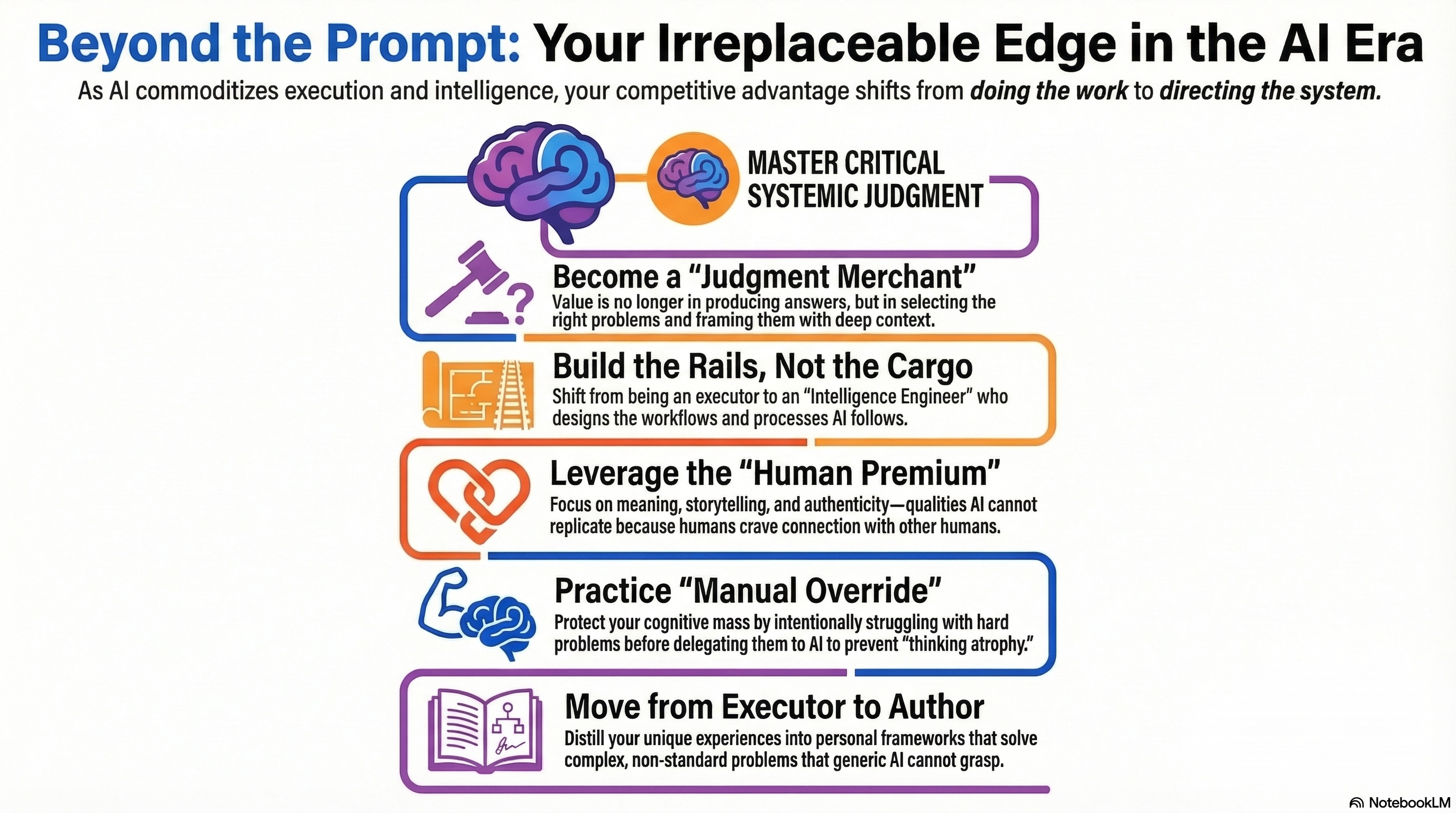
Move from "executor" to meaning-maker. Build judgment under consequence, protect taste in a sea of average output, and preserve the human presence that makes work trustworthy.
Orchestration still matters, but it is the practice layer: the way humans express judgment, taste, and trust through AI-enabled systems.
Interact with this Synthesis
Interested in exploring this topic interactively? Check out our dedicated NotebookLM environment where you can turn this text into Podcasts, ask questions about the source material, and even view the generated visual artifacts.
Open NotebookLM Environment
Project Overview
The Meta-Experiment
This website isn't just about the "Human Premium"—it is a product of it. In this video, Zhijing Eu breaks down the process of co-creating this exact synthesis with Google Gemini.
Watch to learn what happens when you shift from being an Executor of the "Infinite Average" to an Orchestrator of meaning and judgment.
Theme 01
Judgment & Wisdom
For decades, knowledge work was defined by climbing the lower rungs of the DIKW Pyramid (Data, Information, Knowledge, Wisdom). We gathered data, processed it into information, and studied to gain knowledge.
Generative AI has commoditized the first three tiers. It can summarize data, structure information, and recite collective human knowledge instantaneously. The only remaining premium is at the very top: Wisdom and Judgment.
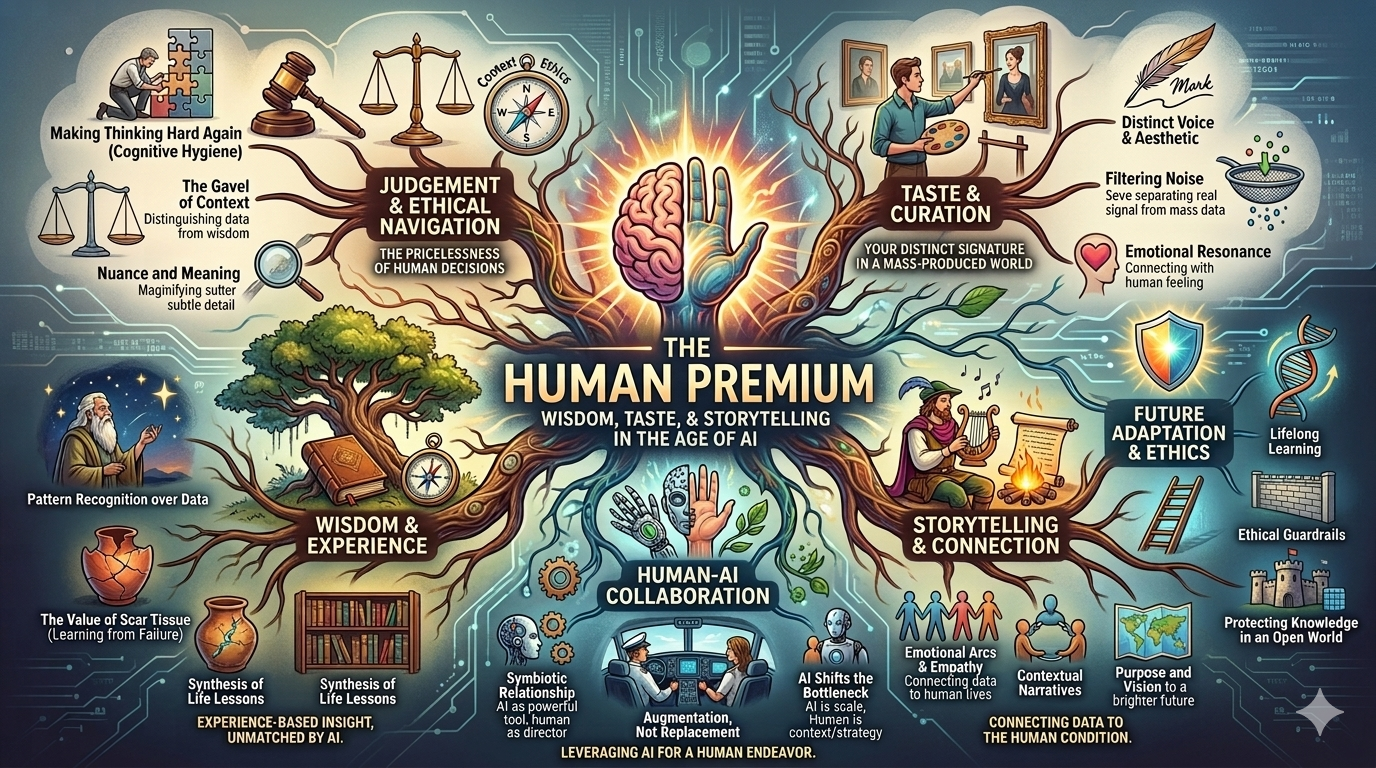
As Peter Hinssen articulates, the Human Premium is the irreplaceable value that emerges when human context meets abundant intelligence. It is the friction of reality applied to the perfection of algorithms.
"Wisdom cannot be generated; it must be applied. It is the human ability to look at technically correct knowledge and decide if it is contextually right for the moment."
Theme 02
Taste & Meaning-Making
If the cost of generating a perfectly structured essay or video script drops to zero, why do we still follow creators, leaders, and authors? Because ultimately, humans want humans.
However, Arvind Narayanan warns of the normalization of AI writing: an influx of grammatically flawless but ultimately hollow text. In a sea of infinite, identical content, taste becomes the ability to select, reject, frame, and make meaning.
To maintain this edge, Joan Westenberg emphasizes the need for rigorous "Cognitive Hygiene." We must actively protect our minds from AI slop, ensuring our curation and storytelling remain fiercely and authentically human. Curation is an act of meaning-making: the human premium is our ability to point at something and say, "This matters, and here is why it matters to us."
Theme 03
Presence, Trust & Human Stakes
The deepest human premium is not simply that we can operate tools. It is that we are embodied, accountable participants in the situation. We notice emotional context, absorb ambiguity, build trust, and carry the consequences of decisions in ways machines do not.
MIT Sloan's EPOCH framework identifies empathy, presence, opinion/judgment, creativity, and hope as human capabilities that complement AI. McKinsey's research on human-agent work similarly notes that social and emotional skills, human oversight, quality control, and human presence remain essential in many high-stakes workflows.
This is where the human premium becomes more than output quality. It becomes trust. In customer conversations, leadership calls, education, healthcare, strategy, and creative work, people still ask: who understands the situation, who is accountable for the tradeoff, and who can I trust when the answer is not obvious?
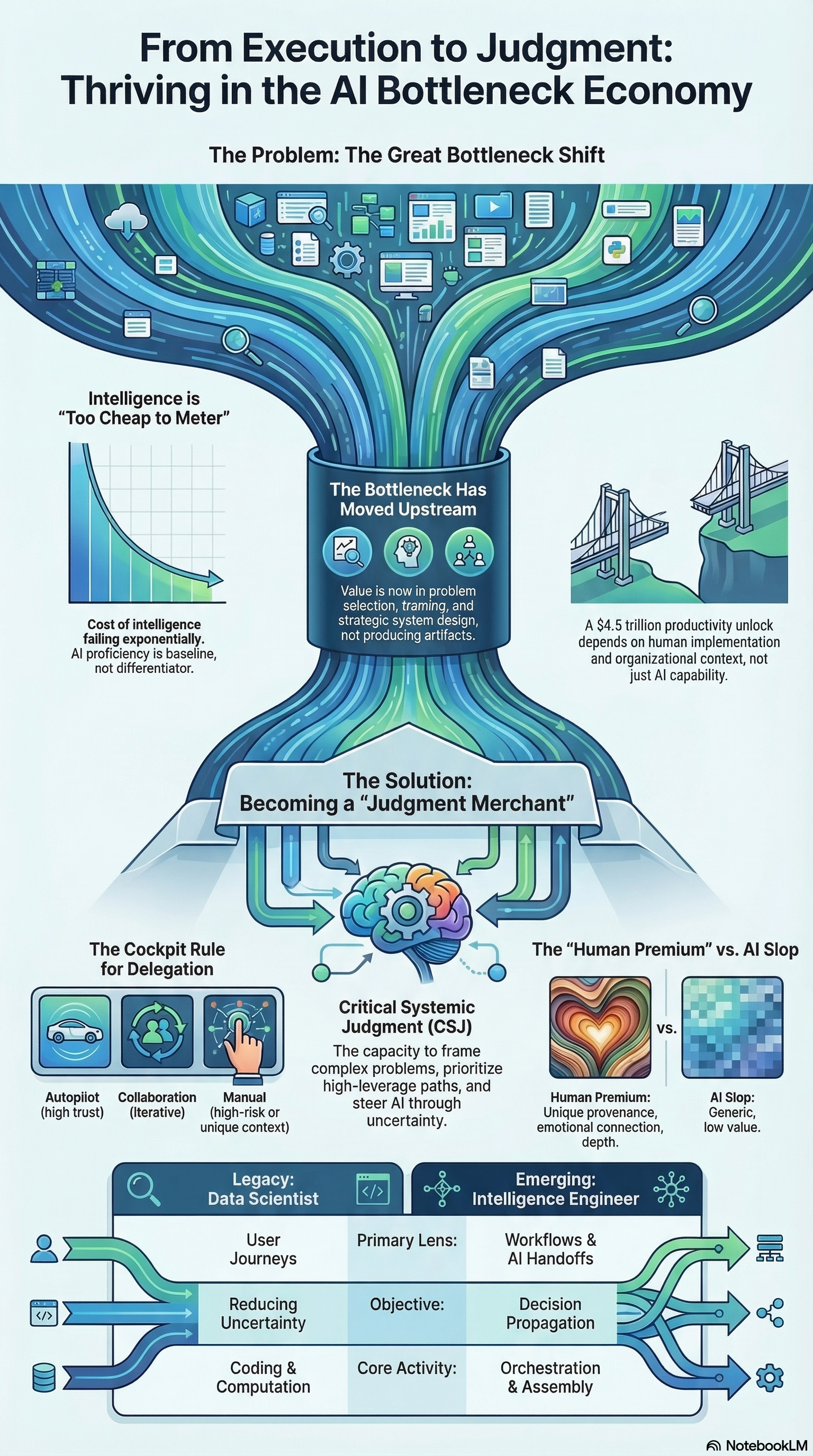
Eliyahu M. Goldratt’s Theory of Constraints (ToC) states that any manageable system is limited in achieving more of its goals by a very small number of constraints. Dr. Lisa Lang applies this directly to our current era: if you use AI to optimize anything other than the true systemic bottleneck, you achieve nothing but excess inventory of ideas.
Historically, the bottleneck in knowledge work was production—the literal time it took to type, code, or design. AI has removed this constraint. We now have infinite production capacity. Therefore, the bottleneck has shifted entirely upstream to human cognition and downstream to integration.
The Dual Human Constraints:
- Meaningful Ideation: We can generate volume, but generating value—synthesizing novel ideas that push humanity forward—requires deep context.
- Consumption & Processing: The human bandwidth to consume information has not changed. Maintaining a rigorous "information diet" and increasing the rate at which we distill that information into decisions is the ultimate bottleneck.
In the Bottleneck Economy, whoever can process the purest information diet and ideate with the highest degree of judgment wins.
Practice Layer
Architecting & Orchestrating
Architecting and orchestrating still matter. They are just not the human premium itself. They are the operating posture for applying the premium inside AI-enabled work.
This is the essence of the Cockpit Rule: you are no longer rowing the boat; you are steering the ship. The goal is to stop merely solving tasks handed to you, and start finding the right problems to solve. An orchestrator aligns disparate AI agents, workflows, and human inputs into a cohesive, high-leverage system.
But orchestration is becoming a baseline skill. Microsoft's Work Trend Index describes the rise of the "agent boss": people who build, delegate to, and manage agents. The durable human edge is what sits above that operating layer: judgment about what should be delegated, taste about what good looks like, and presence when trust and consequences matter.